Hail Damage Repair in Dallas: What PDR Can Actually Fix, and How Your Insurance Claim Works
Not every hail dent qualifies for paintless dent repair. Here's how Dallas drivers can tell the difference, what insurance actually covers, and why speed matters after a storm.
Published · Dent Society
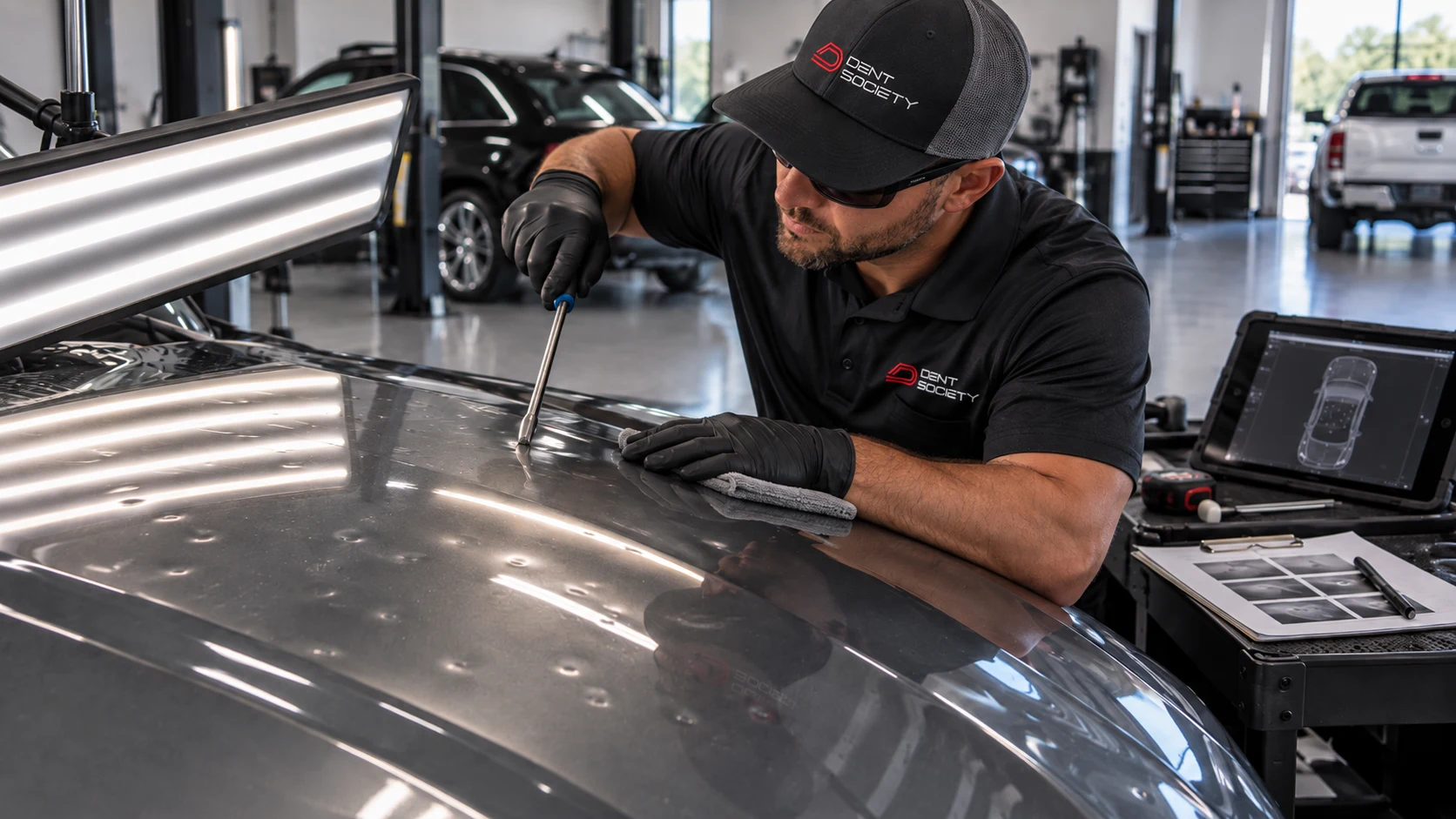
Your Hood Looks Like a Golf Ball. Does That Mean PDR Will Work?
After a Dallas hailstorm rolls through, most drivers open their garage expecting a few dings and instead find dozens, sometimes hundreds, of small dimples across the hood, roof, and trunk. The instinct is to assume every one of those dents is fixable with paintless dent repair. Many may be, but not all are, and knowing the difference before you file a claim changes how you plan the repair.
Paintless dent repair reshapes suitable metal panels with specialized tools, without body filler or repainting. That can preserve the factory finish, but the repair depends on the condition of the paint and metal. PDR is not suitable when the paint is cracked, the metal is stretched or creased too deeply, or a dent sits on the absolute edge of a double-thick panel. Those areas require assessment for conventional bodywork or replacement. Carbon fiber panels cannot be repaired with PDR; damaged carbon fiber panels require replacement under Dent Society's stated repair criteria.
The Physics Behind Why Some Dents Cooperate and Others Don't
A hail dent isn't just a localized dip. The impact stretches the surrounding metal outward, forming what technicians call a crown, a ring of stored tension around the dent itself. Releasing that dent correctly means working the crown down gradually so the panel doesn't spring back into an unstable state known as oil canning, where the metal pops in and out loosely instead of holding its shape. This is slow, deliberate work, and it's the reason experienced technicians spend more time reading a panel than actually pushing on it.
Access matters just as much as technique. Reaching the backside of a dent near a taillight, door edge, or roofline can require removing trim or lowering a headliner while working around wiring, sensors, and other vehicle systems. Ask who will carry out the repair, how access will be obtained, and what training or documented repair experience supports the proposed method. Follow the vehicle manufacturer's procedures when components must be removed or reinstalled.
How a Hail Damage Insurance Claim Actually Moves
Hail damage is generally covered by comprehensive auto insurance, subject to your policy and deductible. Report the storm damage promptly, keep photos, and ask your insurer about coverage and claim requirements. Do not treat a hail claim as a guarantee that your total renewal premium will stay unchanged.
An approved estimate does not automatically mean a $0 out-of-pocket repair. You may still owe your deductible and any work outside the insurer's approved coverage. Confirm the written estimate, deductible, supplements, and your final responsibility with the shop and insurer before authorizing repairs.
PDR avoids filler, refinishing, and paint curing when the damage qualifies, which can shorten the repair process. Actual timing depends on dent count, panel access, parts, insurer approvals, and the shop's workload after a storm. Ask Dent Society for a vehicle-specific schedule after inspection rather than assuming a fixed number of hours or days.
Will the Repair Hold Up, and Will It Show on a Vehicle History Report?
PDR aims to preserve intact factory paint, but paint condition, previous refinishing, dent depth, and repair technique all matter. Paint can be damaged during an unsuitable repair attempt, so the technician must assess those limits before starting.
Avoiding repainting does not guarantee that hail damage or its repair will be absent from CARFAX or another vehicle-history report. Reports depend on information supplied by participating sources. Keep the inspection, repair invoice, and insurance records; no shop can promise that an independently reported damage event will disappear.
Preserving the original finish can be useful when documenting a repair for a future buyer, but it does not guarantee a particular resale value. An honest assessment of the paint and metal is more useful than judging repairability by dent count alone.
Deciding What to Do With Your Vehicle Right Now
If your car has hail damage in Dallas, the useful next move isn't guessing which dents qualify for PDR. It's getting an assessment that separates the panels that can be massaged back into shape from any that genuinely need body shop work, before that assessment becomes part of your insurance paperwork. Dent Society evaluates hail-damaged vehicles against that exact criteria and works within the insurance claim process so you know what's covered and what isn't before repairs begin.
Get a vehicle-specific assessment
If hail has hit your Dallas vehicle, get a panel-by-panel PDR assessment before you finalize your insurance claim, so you know exactly what qualifies for paintless repair and what doesn't. Call Dent Society to schedule that assessment.
Request an assessment · Call (214) 919-2237 · Explore Auto Hail Repair